
When Breaking the Rules Becomes the Cost of Doing Business
When a penalty becomes the cost of doing business, who is it really protecting?
Watching football got me thinking about SMU, corporate accountability, and a different approach to punishing repeat offenders.
What if the consequences helped create jobs and improve wages? I explore the idea in my new article. What would you change?
#CorporateAccountability #ConsumerProtection #CatThomas
If breaking the law is more profitable than following it, what exactly is the penalty preventing?
I’ve been seeing @Jimmy Wrigg on social media, going into Walmart, Kroger, and other stores to challenge what he describes as unethical practices. He checks product weights against the labels and questions whether shoppers are actually getting what they pay for.
Watch Jimmy Wrigg’s video on Facebook
His videos got me thinking about a broader problem: What happens when companies can make more money breaking the rules than they stand to lose when they get caught?
The concerns extend beyond grocery labels to prescription practices. On August 28, 2026, the Justice Department announced a separate $50 million settlement with Walmart over allegations that its pharmacies illegally filled thousands of invalid prescriptions for opioids and other controlled substances. The settlement did not establish liability and included requirements for stronger monitoring and reporting.
In a grocery-weight case, Walmart agreed to a settlement of just under $50 million over allegations that customers were overcharged for certain groceries sold by weight and bagged citrus. Walmart denied wrongdoing.
Those are separate cases, and settlements do not by themselves prove intentional misconduct. But they raise a larger question about deterrence: When does a financial penalty become little more than the cost of doing business?
My concern is the incentive. If a company profits from a violation, pays a penalty, and still comes out ahead, what makes it change? We should be asking whether the consequences are strong enough to prevent the next violation.
The lesson from SMU
Watching football this weekend brought SMU to mind. Fans who remember the Pony Express era know how powerful that program once was. In 1987, repeated NCAA violations led to the cancellation of SMU’s football season and restrictions on its 1988 schedule.
The NCAA’s so-called “death penalty” meant the program lost the ability to compete. That was a consequence it could not simply budget around.
College football and corporate regulation are different worlds. Still, the comparison raises a fair question: What would it take to make repeated corporate misconduct too costly to tolerate?
Make the consequences benefit the people affected
I would like to see a system in which proven, repeated violations trigger penalties tied to a company’s financial size, the harm it caused, and the benefit it gained from breaking the rules.
Consumer restitution and environmental cleanup should remain part of that response. I would add obligations that directly benefit workers and the communities where the company operates.
For example, Walmart reported approximately $19.4 billion in net income in 2025. Imagine a company of that size, after a finding of repeated, deliberate violations, being required to create and maintain 2,000 additional jobs paying $50,000 a year, with benefits, for two years as their punishment.
The salaries alone would total $100 million annually. Assuming another 35% for benefits and employer costs would be $135 million a year, or $270 million over two years.
I would also consider a $2 hourly raise for existing eligible employees during that period. At a company with Walmart’s workforce, that could mean billions of dollars annually, depending on eligibility and hours worked. The obligation would need to be calculated honestly and scaled accordingly.
Workers receiving those wages could support their families and spend money in their communities. The penalty would have a direct, visible benefit to the communities in which they cheated.
Keep the cost from falling back on workers
During the penalty period, the company should be prohibited from offsetting those obligations through layoffs, reduced hours, benefit cuts, or replacing employees with contractors.
If leadership needs to find savings, executive compensation, board compensation, and stock buybacks should face scrutiny. Employees should not have to finance the penalty for decisions made above them.
Enforcement would matter. Independent oversight would need to verify the new jobs, monitor payroll, and prevent a company from moving positions between subsidiaries to make its numbers look compliant.
For companies that repeatedly defy those orders, I would put an 18-month stock-exchange delisting penalty on the table. That is a proposal for debate, not an existing automatic consequence. It would need careful review because employees with retirement savings and other ordinary investors could also be hurt.
The goal should be to make the people directing the misconduct answer for it, while protecting the people who depend on the business.
Test whether stronger penalties change behavior
There are legitimate questions here. Who determines when a violation is deliberate? How do we distinguish repeated misconduct from an isolated mistake? Could forced hiring create jobs that disappear when the penalty ends? How do we prevent costs from being passed to consumers?
Those questions deserve answers. They should help us improve the proposal.
I would support testing this approach through a 15-year pilot, with public reporting and regular independent evaluations along the way. Measure repeat violations, restitution, job retention, wages, and consumer prices. Adjust it when the evidence shows a problem.
I don’t believe cutting jobs should be the default answer whenever a company needs to protect its bottom line. Nor should the people doing the work keep absorbing the consequences when leadership breaks the rules.
A company that repeatedly cheats consumers or damages the environment should face consequences large enough to change its decisions.
Actions have consequences. It’s time those consequences had teeth.
What penalty do you think would actually change corporate behavior?

The Transformation
When I first saw what AI could do in radio, my thought was, “This could eliminate me.”
Being downsized had already forced me to question where my experience fit. Now I had to consider what I was willing to learn.
In “The Transformation,” I share how I’m working through the tension between the radio I love and the changes we face.
What’s a change you initially resisted that eventually helped you grow?
#RadioIndustry #Adaptability #CareerGrowth #ArtificialIntelligence #CatThomas
Why growth and change are necessary for a future in radio
There is a fight going on in my head about the future of radio. Old-school me wants it live and local, the way I grew up with it. New-school me understands that the business has changed and that wanting the old model back will not make it happen.
I still believe the connection between a personality and a community is worth protecting. But protecting what matters requires us to keep growing. Refusing to adapt to a changing business is how we make ourselves obsolete. That is a lesson I have had to apply to myself.
When I was downsized, I asked the same questions many of my radio friends on the beach have asked. What comes next? Where does my experience fit? Does the business still need what I know how to do?
Those are uncomfortable questions. They get more uncomfortable when you realize that technology keeps advancing whether your skills do or not. I have always been a bit of a tech geek, so my instinct is to learn how something works. Even so, when I first saw a SonicTrek AI presentation, my first thought was, "This could eliminate me."
Then I started looking at what else it could do. Could it help personalities extend brands they had spent decades building? Could my programming experience help make the content better? My work with SonicTrek has given me a chance to explore those questions. I began to see how much I could still contribute if I was willing to learn.
What stepping outside radio helped me see
Being outside the day-to-day operation gave me some perspective on our business, including how suspicious we have become of almost every change.
I watched people I knew choose to retire, then saw comments suggesting they must have been pushed out. People reached out to me for the "scoop" and seemed disappointed when the answer was simply that someone wanted to enjoy life. Yes, forced retirements and buyouts happen. I also knew people who made the decision themselves.
I understand where the skepticism comes from. A lot of us have been hurt by this business. But that experience can also make us assume the worst before we know the facts. I had to ask whether I was bringing that same assumption to AI.
I have debated this with good friends and colleagues. Some support what I am doing. Others think I am helping move the industry in the wrong direction. I love and respect them either way. Their concerns deserve an honest answer, and so does the question of what we do next.
What my kids see that we sometimes miss
I have two Gen Z kids, and conversations with them and their friends have challenged me. They use AI and are comfortable experimenting with it. They also notice when our objections depend on whose job we think is at risk.
They have pointed out that some of the same people who object to AI in radio use AI tools to make social videos, graphics, and promotional content. From their perspective, those are skills that people their age are learning and hoping to get paid for. If we are comfortable using technology to do that work, we should at least understand why someone might apply the same thinking to ours.
That does not settle the debate about jobs. It does make it harder to argue that a tool is useful when it saves us money and unacceptable when it changes our own work.
My kids are confident that their ideas and creative ability will keep them valuable as the tools improve. I admire that confidence. They see opportunities to make more things, try more ideas, and build an audience. Radio needs some of that energy if we expect another generation to care about what we do.
Where people still make the difference
What I have learned through SonicTrek is how much the human contribution matters. Someone still has to understand the market, decide what is relevant, and recognize when a piece of content sounds wrong. A familiar voice is part of a personality’s appeal, but so are the judgment and relationships behind it.
That is where our experience can help. We know how to build a format, develop talent, and connect a station to its community. Those skills can guide how technology is used. We also have to learn enough about the tools to do that work effectively.
If our contribution amounts to generic tracks that could run in any city, we should be asking how much value we are adding. A personality who has earned listeners’ trust, supports local clients, and helps drive revenue brings something much more substantial. That does not make anyone immune from a bad business decision, but it gives us a stronger case for our place in the operation.
In the work I have seen with clients, people have been added to support the process rather than downsized. That is my experience with this operation; I would not use it to promise that AI will never eliminate a job elsewhere. It does show me that adopting the technology can also create work for people who know how to use it.
I also believe there is an opportunity for people like my son and his friends to bring their content skills into radio. The question is, will radio create value for them to want to participate. Right now, the answer is no. They may see ways to connect audio with video and social platforms that we have overlooked. We should be willing to learn from them while sharing what we know about serving listeners and building brands.
Think about a mechanic who decided not to learn how to work on computerized cars. The need for repairs continued, but fewer of those repairs were available to that mechanic. Experience still mattered. Keeping that experience useful required learning something new.
Radio is asking something similar of us. We can question how owners use AI, challenge decisions that hurt listeners, and insist on responsible use of a personality’s voice. Learning the tools gives us more ability to influence those decisions and help produce something worth hearing. Refusing to learn leaves us depending on someone else to decide where we fit.
That brings me back to the fight in my head. Old-school me still wants a station that feels connected to the people listening. New-school me understands that keeping that connection alive will require new skills. The way forward is to put my experience to work while continuing to learn.
Growth does not guarantee that every decision will work out or that every job will survive. It gives us a chance to contribute as the work changes. I cannot control every decision an owner makes. I can control whether I keep developing the skills that make my experience useful.
The transformation I needed began when I stopped letting the fear of being replaced keep me from seeing what I could become. I still love radio for the same reasons I always have. I am willing to change how I work so I can keep doing work that matters.
Radio will keep changing. The surest way to lose one’s place in its future is to refuse to change with it.

THE RADIO TUNER ON YOUR PHONE EXPERIMENT
Tune in for radio!
In 2016, I became VP of CHR, Hot AC & Rhythm for Cumulus Media.
I came into the job thinking we had an opportunity to change the direction of radio. Put more local back into the mix. Utilize our PDs in individual markets to help formulate what we played and how we programmed our stations.
I actually held a Friday music meeting with some of our PDs—Leslie Whittle, Davey Morris and Joe Dobbins, to name a few. I tried to rotate other PDs into the mix, including programmers from smaller markets, so they had input and insight into the music selection process. It was a fun collaboration. But I digress.
THEN CAME HURRICANE MATTHEW
In October 2016, Hurricane Matthew was bearing down on Florida's east coast.
One of the stations I was responsible for was WAOA/107.1 A1A in Melbourne, Florida. The National Hurricane Center reported tropical-storm and hurricane conditions in the Melbourne/Cape Canaveral area as Matthew moved just offshore.
At about the same time, something fascinating was happening with smartphones. NextRadio was working with manufacturers and wireless carriers to make it possible for certain Android phones with compatible hardware to receive live, over-the-air FM radio. Not streaming. Not cellular. Actual FM radio.
That distinction became incredibly important with a major hurricane approaching.
We knew there was a possibility that power, internet service and cellular networks could be disrupted. So WAOA PD Mike Vincent began telling listeners that if they had a compatible Android phone, they should download NextRadio. If cellular or internet service became unavailable, they could still receive local FM broadcasts and emergency information over the air.
After Hurricane Matthew passed, I contacted the NextRadio people and asked what they had seen.
My recollection is that they usage in our area had increased by nearly 400% during the week of the storm. I haven't been able to locate the original market-level report to independently verify that exact number a decade later, so I'm relying on my recollection of that conversation. But subsequent NextRadio research documented the same basic phenomenon: during major weather emergencies, people with FM-capable phones increasingly turned to local radio for information. That experience stuck with me. It was the silver bullet.
Why shouldn't every smartphone be capable of receiving free, over-the-air local radio?
No subscription. No paywall. No cellular data required. And, perhaps most importantly, another communications path when other infrastructure fails.
SO WHY DIDN'T IT HAPPEN?
This is where the story gets more complicated than I originally remembered. Ajit Pai became FCC Chairman in January 2017. Pai had previously worked as Associate General Counsel at Verizon from 2001 to 2003 before eventually joining the FCC and becoming a Commissioner.
But here's something important: Pai actually supported activating FM capability in smartphones.
Shortly after becoming Chairman, he publicly argued that there was a compelling public-safety case for activating FM reception in smartphones. What he did not support was an FCC mandate requiring manufacturers or carriers to do it. He believed the marketplace should make that decision.
Later that same year, after Hurricanes Harvey, Irma and Maria, Pai publicly called on Apple to support FM reception, saying that when wireless networks go down, smartphones capable of receiving FM broadcasts could provide Americans with potentially lifesaving information. Think about that for a moment. The Chairman of the FCC publicly acknowledged the value of having free broadcast radio available on the device almost every American carries. Yet the FCC stopped short of requiring it.
Apple responded that its newer iPhone 7 and 8 models did not contain the necessary FM radio hardware and antennas to enable reception. The National Association of Broadcasters disputed portions of Apple's characterization based on its own teardown research and continued urging Apple to include FM capability in future devices. FCC officials also acknowledged at the time that it wasn't clear whether the agency had the legal authority to mandate FM activation.
And ultimately, the marketplace decided. Look at your phone today. We know how that turned out.
WHICH GOT ME THINKING ABOUT THE FCC
Who at the FCC has actually worked in broadcasting? Not regulated broadcasting. Not represented broadcasters as an attorney. Not studied broadcasting. Not written policy about broadcasting.
Actually worked inside a radio or television station. Programming. Sales. Engineering. Management. Operations. Running a station every day and being responsible for serving a local community while also generating enough revenue to keep the lights on. I started looking and what I found surprised me.
The current FCC has three Commissioners: Chairman Brendan Carr, Commissioner Olivia Trusty and Commissioner Anna Gomez. All three have extensive professional qualifications in communications law, telecommunications policy, government and regulation. But I have found no documented professional experience among the current Commissioners of actually working inside an AM/FM/TV broadcast station. I then looked at the publicly available biographies of their senior staffs and current senior Media Bureau leadership. Again, I found considerable expertise in law, regulation, government, telecommunications, wireless and technology. What I did not find among the senior people was significant professional experience actually operating a terrestrial station.
I want to be careful here: the FCC employs hundreds of people, and detailed employment histories aren't publicly available for every career employee. There may well be people within the agency who have worked at radio or television stations. But at the Commission and senior leadership level, station-level broadcast operating experience is remarkably non-existent.
THEN I FOUND JIM QUELLO
To find an FCC Commissioner with substantial professional experience actually running broadcast facilities, I had to go back nearly three decades.
James H. Quello.
Quello entered commercial broadcasting, joining WXYZ-AM in Detroit before moving to WJR. He eventually became Vice President and General Manager of WJR and spent decades in broadcasting. His career included programming, management, community service and industry leadership.
He is even credited with helping put legendary Detroit personality J.P. McCarthy into a key drive-time position. McCarthy went on to dominate Detroit morning radio for decades.
Quello joined the FCC in 1974 and served approximately 23½ years, including a period as Acting Chairman. His FCC tenure ended in 1997. That means it has been nearly three decades since the Commission included someone with that level of hands-on station management experience.
And something Quello said after leaving the Commission stopped me cold.
In the May 10, 2002 issue of Radio & Records, Erica Farber interviewed Quello about his broadcasting and FCC careers.
Explaining why he wanted to serve on the FCC, Quello said:
“The one thing that bugged me was that the commission had an average of power and a shortage of practical knowledge.”
That's quite a statement from a man who spent more than two decades on the Commission.
Quello believed at least one Commissioner should understand what it meant to be responsible for the financial success of an actual communications business.
He also told Farber that his industry experience allowed him to understand its strengths and weaknesses. And when the discussion turned to radio's future, Quello's prescription was remarkably simple:
“Local, local, local.” He believed local service and civic involvement were fundamental to radio's future. Twenty-four years later, I think his observation about practical knowledge deserves another look.
THREE QUESTIONS
1. Does today's FCC have people who understand radio regulation?
Absolutely. There is tremendous expertise inside the agency involving communications law, spectrum, allocations, licensing, interference, ownership and technical regulations.
2. Does today's FCC leadership have exposure to the communications industry?
Absolutely. There are people with backgrounds in wireless, telecommunications, technology, communications law and government policy. But those things aren't necessarily the same as running a broadcast facility and understanding daily operations and challenges.
3. Does today's Commission include someone who has actually programmed, managed, sold, engineered or operated a commercial radio station?
Based on the professional histories I have been able to document, no current Commissioner or Senior Staffer does. And that raises a larger question.
WHAT HAPPENS WHEN THE PEOPLE MAKING THE RULES HAVE NEVER DONE THE JOB?
This isn't an argument that attorneys, engineers, economists or telecommunications experts don't belong at the FCC. Of course they do. The communications ecosystem is enormously complicated.
But shouldn't broadcasting expertise have a seat at that table too?
The FCC regulates an industry built around something very different from most digital platforms.
Broadcasting is local. Its spectrum is public. Its signals are freely available. Its licensees have public-interest obligations. And during emergencies, local broadcasters can continue delivering information without every listener establishing an individual data connection to a cellular network.
That brings me right back to that phone in my pocket.
WHAT IF A RADIO TUNER HAD BECOME STANDARD ON EVERY SMARTPHONE?
Imagine if, beginning around 2016, every smartphone sold in America had included an easy-to-use FM receiver alongside its other standard functions. No special app hunt. No subscription. No data plan required to listen. You tap RADIO just as easily as you tap Spotify, YouTube, Apple Music or another audio app. What would radio look like today?
Would more young people have discovered local radio because it was sitting on the device they use all day? Would radio have become a more important part of the mobile ecosystem?
Would broadcasters have had a stronger incentive to invest in personalities, local news, community information, sports, events and compelling local programming?
And during a hurricane, wildfire, earthquake or widespread network outage, wouldn't having another independent way of receiving emergency information be valuable? Those questions matter even more because the economics are different. Streaming audio requires data infrastructure and exists inside ecosystems built around subscriptions, advertising, data consumption, apps and user engagement.
An FM receiver doesn't. Once the phone contains the necessary receiving hardware, the radio signal arriving at that device is free over the air. That doesn't prove that wireless carriers or technology companies deliberately kept FM out of smartphones to protect revenue. I haven't found evidence strong enough to make that accusation. But it does raise a legitimate policy question:
When the marketplace decided whether Americans would have free broadcast reception built into their phones, were the financial incentives of the companies making those decisions necessarily the same as the interests of consumers and local communities?
That's a question worth asking.
MAYBE JIM QUELLO WAS RIGHT
Maybe the FCC doesn't need fewer lawyers, engineers or technology experts. Maybe it needs a few more broadcasters. Someone who has sat in a station during a tornado warning. Someone who has watched the phones light up when a community needs information. Someone who understands why a local personality matters. Someone who has had to make payroll. Someone who has sold advertising, dealt with ratings, hired talent, programmed music, managed an engineering problem and stood in a conference room trying to figure out how to keep a station relevant.
Someone with what Jim Quello called “practical knowledge.”
Would FM reception on every smartphone suddenly solve all of radio's problems? Of course not. Radio still has to create something people want to hear. But access matters.
If free local radio had occupied a permanent place on the device Americans carry everywhere, I believe broadcast radio would have had a much stronger opportunity to compete for mobile listening. Maybe that opportunity has passed. Or maybe it hasn't.
Perhaps the real question isn't whether government should force Americans to listen to radio. It shouldn't.
The question is whether Americans should have had—and perhaps should still have—the choice to receive their local broadcast stations easily, directly and free on the most important communications device they own. So I'll leave you with this:
Would putting free over-the-air radio on every smartphone be a game changer for broadcasting today?
Or are we just throwing spitballs at a grizzly bear? I'd love to hear your perspective.
And if anyone from he FCC is reading this, I’m available and willing to work relatively cheap because broadcasters deserve a seat at the table from someone who has sat in the chair. Call me!
Sources: Federal Communications Commission statements and personnel records; National Association of Broadcasters; National Hurricane Center; Radio World; Michigan State University's James H. Quello Center; Erica Farber, “Publisher's Profile: James Quello, Former FCC Chairman and Commissioner,” Radio & Records, May 10, 2002, p. 104.
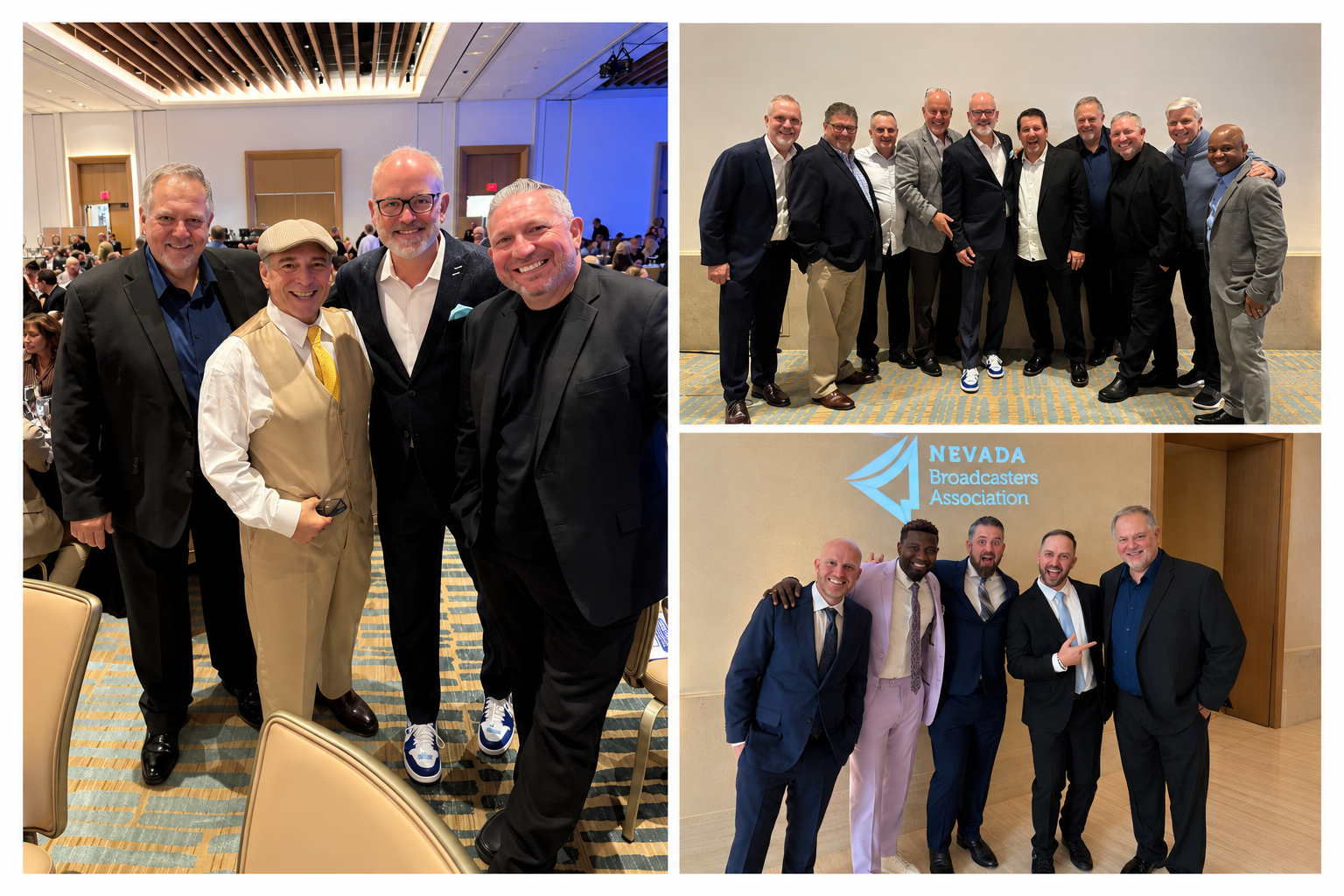
WE DIDN'T TALK ABOUT THE MUSIC
The Nevada Broadcasters Association Hall of Fame Gala turned into a bit of a KLUC reunion. We started telling stories about the great stuff we did. Toy Drive. Bieber Bandit. Party Patrol. The Party Cruise. Hi-Lo to Mexico. Blackjack with *NSYNC. HORSE with Imagine Dragons. And a certain KLUC Summer Beach House that listeners desperately wanted the address to—even though it didn't actually exist. 😂 Then it hit me. We weren't talking about the music. We were talking about the experiences. That is what great brands bring.
In my position, I get to listen to and talk with a lot of people in and around the broadcast industry.
This past weekend was exceptionally gratifying. It was the Nevada Broadcasters Association Hall of Fame Gala. The Lifetime Achievement Awards for Southern Nevada went to Sherry Swensk for television and Chet Buchanan from 98.5 KLUC for radio.
Now, the only bad thing I can say about Sherry is that we played media-league softball against her Channel 8 team and lost a few times. Okay, we won more than we lost—but we always had a great time!
Several other people were inducted into the Nevada Broadcasters Hall of Fame, including John Moug, Tim "Rayne" Rainey and Bojo Ackah. What made the night especially meaningful to me was that I had hired all of those guys when I was at CBS/Las Vegas. I know JB King, who was there and was my programming partner for years, felt the same way. When I left the CBS group to become a format VP at Cumulus, JB continued to nurture what we'd planted.
Shout out to Other fellow fun seekers, including J-Love, Mojoe Roberts, Phil "Dangerboy" Maiorano, Joyce “Juicy” Balaoro, Chuck Field, Ken Benson, Jeff Conwell, Gus Pohrman-Swanson, and Casey McCabe, who all helped make it a great night.
But something happened that really stuck with me. Listeners and community organizations actually attended the gala because of their connection to these personalities.
Think about that. How much do you have to matter to your audience for them to come and watch you receive an award?
How fulfilling is it to return to a city you've been away from for years and have people recognize you, remember you and still be excited to talk with you? How exciting for those that still live and work here, to be shown the love and recognition you spend your career building? THAT is what we're missing.
As our old KLUC crew talked that night, something became obvious. We didn't spend much time talking about which songs were Powers. We didn't talk about rotations. We didn't reminisce about whether a record should have gone from 52 spins to 85.
What we did talk about was Toy Drive, Bieber Bandit, Party Patrol, The Party Cruise, Hi-Lo to Mexico, etc.
We talked about having listeners play blackjack with *NSYNC. We talked about playing HORSE on a pop-up basketball hoop with Imagine Dragons. We talked about the things that made being a listener fun.
Those were experiences. Those created lifelong stories. Those were memories we cherished and shared with our listeners. And, importantly, they started with the audience.
Create something people love first. Figure out how to monetize it second.
Somewhere along the way, much of radio flipped that equation.
YOU CAN'T WIN WITH ONE PITCH
I get tired of hearing that Gen Z and younger Millennials don't listen to radio.
But there's an uncomfortable truth buried inside that criticism. Maybe the problem isn't that radio can't connect with younger audiences. Maybe we haven't given them enough reasons to care.
Great brands remind me of great pitchers in baseball. You can have an amazing fastball. Maybe you can blow it past everyone the first time through the lineup. Eventually, though, hitters adjust.
They've seen it. They know what's coming. They catch up.
For radio, music became our fastball. And it's still incredibly important. But somewhere along the way, we started acting like having the right songs in the right order was enough to create an emotional relationship with an audience. It isn't. Great stations—and great brands—need more pitches.
ENTERTAINMENT
Give me personalities who make me laugh, think, react or simply feel better about my day. Create contests and promotions people actually remember. Give listeners experiences they couldn't have created themselves. Give them stories they'll tell their friends.
INFORMATION
Be useful. That doesn't mean every station needs to become a news station. It means knowing what's happening in your listeners' world. Lifestyle information. Local events. Breaking news. Weather emergencies. Traffic. Community issues. When something happens, your audience should know you're there.
COMMUNITY
Actually live in the community you claim to serve. Sometimes that's something small, like helping a kid battling cancer fulfill a wish to be on the radio. Sometimes it's living on scaffolding for 12 days in December collecting toys, bikes and money so kids who otherwise might not have much of a holiday have something under the tree. Both matter. Because community isn't a liner. It's something you do.
AUTHENTICITY
This may be more important today than ever. Be who you say you are. Your audience has access to too much information today to maintain some carefully manufactured persona forever. Be honest. Be human. And when you're wrong, own it. Credibility takes years to build and seconds to destroy.
THEATER OF THE MIND STILL WORKS
One of my favorite memories was the KLUC Summer Beach House.
We spent months collecting audio from artists and celebrities, all pretending they were hanging out at our exclusive summer beach house. Pitbull was grilling burgers. Eminem was hanging out in the Jacuzzi. Rihanna was chilling on the deck. There was only one little problem. There was no beach house.
But we created an entire world around it, and listeners were begging us to tell them where it was. That's theater of the mind.
We even opened the first-ever UNDERGROUND THEME PARK IN THE DESERT on April Fools' Day. Again—none of this happened because one person had an idea. It took a team. People had to conduct interviews. Talent had to sell the story on the air. Producers had to build the audio. Someone had to schedule the pieces. Promotions had to extend the idea into the streets. Sales had to find ways to monetize it without destroying what made it fun. Everyone owned a piece of the puzzle. And when everybody cared about their piece, we created magic.
Here's the crazy part: Imagine what we could do with those ideas today. Social media. Video. TikTok. Instagram. YouTube. Streaming. Podcasts. Texting. Push notifications. The Summer Beach House wouldn't just live inside the radio anymore. We could let listeners see inside the world we were creating. The technology didn't kill our ability to create theater of the mind. It gave us a bigger theater.
SO WHY AREN'T WE DOING MORE OF IT?
Because this kind of radio takes people. It takes talent doing interviews. It takes producers creating audio. It takes promotion people developing ideas. It takes programmers building the story. It takes salespeople who understand that the best sponsorship opportunities often begin with creating something audiences actually want—not figuring out what inventory still needs to be sold this month.
Creativity isn't always efficient. Neither is building a relationship. But relationships are exactly what we're asking listeners to have with our brands. For years, much of radio focused heavily on serving the audiences it already had while younger Millennials and Gen Z built relationships somewhere else.
Now Millennials are firmly inside the 25–54 demographic, and older Gen Z listeners are entering it.
We're suddenly asking: How do we get them back? Maybe that's the wrong question.
Maybe the better question is: What are we giving them that's worth coming to?
Music is everywhere. What they can't get everywhere is your people. Your experiences. Your community. Your creativity. Your personality. Your local connection. Your ability to make them feel like they're part of something.
That's what I was reminded of at the Hall of Fame Gala. Years later, nobody was standing around talking about what songs were in Power.
We were talking about what we did. What we created. Who we helped. How much we laughed. And the listeners who showed up that night reminded me of something else: They remembered, too.
So maybe the question for everyone running a radio station—or any brand—is pretty simple: Twenty years from now, what will your audience remember about you?
And more importantly...What are you doing today that's worth remembering?
#Radio #Broadcasting #RadioIndustry #Media #MediaLeadership #ContentStrategy #AudienceEngagement #LocalRadio #BrandBuilding #CommunityEngagement #BroadcastMedia #RadioProgramming

The Story of Our “Heaven 9/11”
3 Girls pictures from 2011 and today for comparison.
As we look back and honor the lives lost on September 11, 2001, there is a piece of history that still gets played every year. A song that continued to grow through the years. Today, it can be found with a simple Google search. Here is one of the many versions you’ll find:
https://www.youtube.com/watch?v=mf6n7lanqEY
What is interesting is that people share this song around the world, but none of them have the story from inside the room where it was created.
I know because our band of merry idiots at 98.5 KLUC created it.
I will say that we were inspired by an earlier version featuring a little girl talking to her father, who had passed away during the 9/11 attacks.
In 2011, as the 10th anniversary of that tragic day approached, J.B. King had the idea to update the original version. He wanted to create something that reflected how the children had grown and how their lives had progressed during those 10 years.
The first girl you hear is Aria, the daughter of our marketing director.
The second girl is my own daughter, Jillian, who was born just 16 days after 9/11.
I wanted to capture the raw emotion the entire nation was feeling, so Jillian and I sat down and watched a story about the children of 9/11—kids like her who had lost a parent in the attacks and would never have the chance to know them.
A year earlier, I had been up for a job in New York. I didn’t get it, but I explained to Jillian that we could have been living in New York City when the attacks happened. It was possible that she could have been one of those children who lost a parent that day.
As we both became teary-eyed, I did what all good radio dads do: I turned on the microphone and recorded her saying those words for the song.
To this day, when I hear the raw emotion in her voice—and know that it came from the empathy she felt for those children—it brings me to tears.
The final girl you hear is Memory. She was a teenager in the same youth theater group as my kids, and she performed the role of the older girl in the song.
I’m not at a radio station today where I can help facilitate another update of the song for the 25th anniversary. Still, it is incredibly gratifying to know that our group of misfits created something so powerful and meaningful that it continues to live on today.
I’ve been asked why we didn’t copyright it or put it online ourselves to monetize it.
But something like this is about sharing it with the world. It would seem almost criminal to do anything other than allow people to experience the emotional roller coaster we all feel every September 11.
I’ve seen the song posted on many YouTube channels, and I have never demanded that it be taken down. If anyone is making money from it, all I ask is that you do the right thing and donate that money to an organization supporting first responders.
Finally, I want to recognize the people who helped make this happen. Last names have been redacted to protect the innocent:
J.B., Juicy, Aria, Jillie, Memory, Spence, JJ, Chet, Lauren, Showkiller/Davey, Amberly, and the entire crew at 98.5 KLUC in 2011.
I’m sure I have missed someone, so I apologize upfront.
Twenty-five years later, we remember the lives lost, the families forever changed, and the first responders who ran toward danger while everyone else was trying to escape.
We will never forget.
#NeverForget #September11 #PatriotDay #HonorAndRemember #September11Memorial #911Remembrance #UnitedWeStand

THE 100 = 75 RULE
I remember DJ’ing to help get myself through college. While I was at Ohio State, I met my friend Brian Crompton at a DJ gig at the Roller Chalet in Westerville. As we became friends, we got the idea to start our own DJ company—weddings, school dances, parties, etc.
I remember coming home one night after DJ’ing a dance at Westerville South. I had to haul in my record crates, amps, speakers, coffin, and everything else that came with doing a mobile DJ gig.
It always seemed like loading in and loading out was more work than actually playing the gig. It was the part of the job I always complained about.
One day, my dad finally got tired of hearing me bitch about it and gave me a simple piece of advice that has stuck with me ever since:
“100% of your complaints account for 75% of your income.”
Plainly put, you don’t get paid for the fun, easy stuff that anyone can do. You get paid to be good at the stuff nobody wants to do.
He gave me another piece of advice that day:
“Do the things you hate first. That way, they’re done and out of the way.”
Simple advice, but I’ve carried both lessons with me throughout my career.
Too often, I see posts online or hear people complain about the parts of their jobs they don’t like. We all have them. But if I could offer one piece of advice, it would be this:
Don’t fight the stuff you hate. Embrace it.
Get good at it. Maybe even become better at it than everyone else.
Because the easy, enjoyable parts of a job are usually the things everyone wants to do. Your real value often comes from your willingness and ability to tackle the difficult, tedious, or uncomfortable things that other people avoid.
Success isn’t just about being great at the things you love.
Sometimes, it’s about being great at the things you’d rather not do.
And whenever I find myself complaining about those parts of the job, I can still hear my dad reminding me of The 100 = 75 Rule:
“100% of the hardships of the job account for 75% of your income.”
Funny how some of the best business advice you’ll ever get has nothing to do with business.
#Leadership #CareerAdvice #ProfessionalGrowth #WorkEthic #SuccessMindset #BusinessLessons #LifeLessons #PersonalDevelopment #Careers #CatThomasMedia

OMG…Every Business Needs More Cheerleaders!
Cheerleader at Summit in Orlando after winning the National Championship.
Every successful station I’ve run had a great group of cheerleaders.
They were engaging. Likable. Proud to carry the flag. Being associated with our brand wasn’t just a job to them—it was personal.
And because it mattered to them, they showed our audience and our clients why it should matter to them, too.
Unfortunately, what I’ve seen at far too many stations—and businesses in general—is that we’ve killed the cheerleaders.
Most of us who have spent our careers in radio, love radio.
We love the creativity. The people. The listeners. The competition. And yes, let’s admit it, we enjoy the occasional ego stroke that comes with success.
When people used to ask me about my job, I’d tell them, “Hey, it beats working for a living.”
And I meant it.
As long as I was making a decent living, my family was happy, I had decent benefits, and I was treated like a valuable member of the team, I was good. I don’t think I was ever the highest-paid person in the building. I was never particularly motivated by money. The folks on Shark Tank would probably think I’m nuts.
In fact, I regularly negotiated contracts for talent who made more money than I did. I was perfectly fine with that. Great talent could do things I couldn’t do. They were essential to my success, just as I was part of theirs.
For me, radio was never just a job. It was a lifestyle.
And I think you’ll find that same passion in many of the most successful people in any business.
When an “Expense” Walks Out the Door
What fascinates me is how many talented, passionate people have been downsized from our industry.
I understand why it happens. Someone, somewhere, is looking at a balance sheet. There’s a number that needs to be hit this quarter, and payroll is an easy line to see.
What’s much harder to see on that spreadsheet is the value of the relationships walking out the door. The talent. The programmer. The salesperson. The promotions person. The marketing person. The person who has spent years building relationships with listeners, advertisers, artists, managers, labels, community leaders, and local businesses. Those relationships have value. Sometimes, a lot of value.
I’ll leave names out to protect both the innocent and the guilty, but I’ve watched RIFs in multiple markets cost stations enormous amounts of local revenue. They won the quarterly battle and lost the war.
Then the explanation becomes: “The local market is declining.” But is it? Local advertising dollars haven’t simply disappeared. The bigger question is where those dollars are going—and why advertisers are choosing to spend them somewhere else.
Here’s the part we sometimes don’t want to admit: Clients don’t only buy stations. They buy people. They buy trust. They buy relationships. They buy the confidence that the person sitting across from them understands their business and can help them get results. It’s like kicking out your roommate who owns the couch and then complaining that you have nowhere to sit.
The Real Brand May Not Be Your Logo
We talk endlessly about our “brand.” But sometimes the real brand isn’t the logo, the frequency, the slogan, or the call letters. Sometimes the brand is the person your client trusts. Relationships matter.
I watched one RIF where, within days of someone leaving the building, several clients left too.
One client alone represented roughly four times what that employee was making. More than a year later, that client still refused to advertise with the company. Think about that.
The company saved a salary—and lost multiples of that amount in business. The product technically still existed. But in that buyer’s mind, the product they loved and had been buying was gone.
And Now There’s Another Problem
Today, talented people who are downsized have options they didn’t have 15 or 20 years ago. They can keep creating. They can build podcasts. They can produce video. They can create social content. They can consult. They can build their own brands and audiences.
And guess what? Advertisers can follow them.
That means radio isn’t always “losing” advertising dollars to digital. Most of the time, they are driving those dollars away themselves.
Someone who gets downsized isn’t going to sit home forever waiting for the phone to ring. They’re going to figure out how to make a living. And if they already have trust, relationships, an audience, and the ability to produce results, advertisers have plenty of ways to spend money directly with them.
Ratings and reach still matter. But so do trust, loyalty, relationships, and perceived results.
Would I Go Back?
Someone recently asked me if I would go back to working in radio. YES.
But only somewhere that understands that success creates revenue—not that revenue magically creates success.
I love this business. I love working with young talent and watching them grow. I love competing. Okay, honestly, I love fighting with competitors. Most of all, I love watching an audience get excited about their station.
What concerns me is how few companies seem willing to invest in the years of expertise and relationships that experienced people bring with them. Look around. There are some incredibly talented programmers, personalities, managers, and broadcasters sitting on the beach right now. People who could help develop the next generation of talent. People who could mentor young programmers. People who know how to build brands, create excitement, connect with communities, and generate revenue.
Instead of going to that well of knowledge, sometimes it feels like we’d rather keep moving the shells around and hope we get lucky enough to find the quarter underneath.
You Can’t Cut Your Way to Passion
Here’s the bottom line: You cannot keep cutting valuable assets and then expect clients to pay full price for a damaged product.
Years ago, Warren Buffett reportedly shared a thought with a friend of mine here in Las Vegas. I’ll paraphrase it because I wasn’t in the room:
You don’t save your way into prosperity.
That idea has stuck with me. Winning requires more than efficiencies. It requires belief in the organization. People who care whether it wins. People who carry the flag when nobody is asking them to. People whose enthusiasm becomes contagious to coworkers, listeners, clients, and the community.
Every great station I’ve ever been around had those people. They were the cheerleaders.
So if you want to build a successful brand instead of simply managing its decline…
EVERY BUSINESS NEEDS MORE CHEERLEADERS.
#Radio #Broadcasting #RadioIndustry #Media #Leadership #LocalRadio #RadioProgramming #TalentDevelopment #Advertising #CompanyCulture #BroadcastMedia #MediaLeadership

AI: Tool or Taskmaster?
Outside of politics, artificial intelligence might be the most divisive topic today.
There are legitimate concerns about privacy, cyberstalking, the collection of personal information, autonomous decision-making, and AI replacing human workers. Those concerns are real, and we need intelligent regulations that protect people without preventing innovation.
That said, I have several friends and family members who refuse to use AI in their jobs. I find that incredibly shortsighted. In fact, I have a friend who tells hiring managers during job interviews, “I won’t use AI.” So, what happens next? You know the answer. Next candidate.
Here’s what I’ve learned: Don’t give AI personal or confidential information. If you give it access to your banking records, private emails, medical information, passwords, or other sensitive parts of your life, you may be asking for trouble down the road. However, you still need to learn how to use AI as a tool.
Think about how technology transformed the media business. There was a time when companies relied almost entirely on scriptwriters, commercial artists, photographers, editors, and production specialists. Then came programs such as Adobe Photoshop and Illustrator, along with digital photography, computer graphics, and desktop video editing.
The people who adapted didn’t necessarily abandon their creativity. They used technology to work faster, improve the details, and expand what they could accomplish. Those who refused to adapt often found themselves left behind.
AI is another one of those turning points. I challenged my anti-AI friend to try living a truly AI-free life.
Get rid of Alexa. Disconnect the security system that recognizes faces or distinguishes people from packages. Cancel the streaming services that recommend what to watch. Stop using social media and search engines. Give up the smartphone, smart television, tablet, and many of the newer features in your car. AI is already embedded in many of the products and services we use every day.
I also find it ironic when someone complains about AI taking jobs while using CapCut or another app to create and post videos. That technology allows one person to do work that might once have required a video editor, photographer, videographer, graphic artist, or producer. Apparently, replacing someone else’s job with technology is acceptable—as long as the technology is working for you. Yes, that example is intentionally extreme. But it is difficult to claim that you want nothing to do with AI while benefiting from it every day.
Here is what we should demand. Intelligent regulation and responsible use. I don’t count on the companies to self regulate in the best interests of the public. So we need to find ways to make sure they play inside the lines.
AI used as a tool can be incredibly valuable. It can make creative people more efficient and help them turn ideas into reality without losing their original vision in someone else’s interpretation. It can organize information, refine language, generate possibilities, and handle routine tasks that consume valuable time.
AI given too much authority, too much personal information, or too little human oversight can be hazardous and extremely disruptive.
My advice is simple: Think of AI as a personal assistant—not your boss, your conscience, or your replacement. Don’t give AI anything you wouldn’t want displayed on a huge sign in your front yard. Be cautious about giving it access to personal or confidential information. Question its answers. Check its work. Make the final decisions yourself. But learn how to use it.
Let AI help you develop your vision, organize your thoughts, improve your communication, and handle simple, menial tasks. The idea should still be yours. The judgment should still be yours. The final product should still reflect you.
And, for the record, I wrote this article. AI performed the grammar and punctuation check.
See? My idea. My opinion. My voice. AI was simply the tool that kept me from looking like a fifth grader writing a book report.
#ArtificialIntelligence #FutureOfWork #ResponsibleAI #AIInTheWorkplace #DigitalTransformation #MediaInnovation #CareerDevelopment

Talent…You Need To Matter!
Three energetic radio hosts pose together in a modern broadcast studio promoting CAT RADIO. The lineup features a stylish white male host in his 50s, a smiling Latina female host in her 30s, and a Black male host in his 30s, standing behind a professional mixing console with CAT RADIO-branded microphone flags. Bold black and yellow graphics, broadcast equipment, and the slogan "Wake Up. Laugh Loud. Turn It Up!" create a high-energy morning radio show atmosphere.
We've all lived through layoffs, downsizing, and watching companies struggle while shareholders somehow continue to do just fine. If you want an interesting perspective on how some of today's wealthiest business leaders are beginning to think, watch Nick Hanauer's TED Talk. Whether you agree with every point or not, it's worth your time. https://www.youtube.com/watch?v=th3KE_H27bs
But as easy as it is to point fingers at corporate America, those of us in radio have to own our part of the industry's struggles. We can't control Wall Street. We can't control budget cuts. We can't control who owns our stations. What we can control is whether we matter.
I've always believed that being a great radio personality isn't a four-hour shift. It's a 24/7 lifestyle. That was true long before social media ever existed. The personalities who built legendary careers didn't just show up for their air shift and head home. They were where their listeners were. They were at clubs, concerts, football games, community festivals, pool parties, charity events, remote broadcasts, high school football tailgates, basketball watch parties, and they tuned in for promotions like Party Patrol, Party Cruises to Mexico, Concert & Movie Tickets, and other giveaways. They made weekends special.
They became part of the community—not just a voice coming out of a speaker. Today, social media influencers understand this better than many radio personalities do. They're constantly engaging their audiences, documenting their lives, creating conversations, and building loyal communities. So why aren't we matching that energy? We have every opportunity they do—and one massive advantage they don't. We have the radio.
If you think playing highly researched music, voice tracking a shift, or simply showing up for your four hours on the air is enough to build a lasting career, you're fooling yourself. There are certainly a few formats where a passive approach can survive. But more often than not, that's only because no one is seriously competing for your audience. The competitor that always worried me wasn't necessarily the station with the biggest signal or the best music logs. It was the station that was everywhere.
They showed up at college homecomings. Pool parties. Soccer tournaments. Community festivals. Everywhere listeners gathered, they were creating memories, relationships, and fans. Those relationships eventually followed people back to the radio. That's how brands are built.
Too often, stations become comfortable. Staff members get burned out. Management cuts budgets. There aren't enough people to cover events anymore. Then a hungry competitor comes along, outworks everyone, becomes part of the community, and suddenly the heritage station can't figure out why the ratings are slipping. It's simple. They stopped mattering.
One thing that always puzzled me was hearing personalities complain about working a two-hour remote on a Saturday that paid $100 an hour. I'd do the math for them. At $100 an hour, that's the equivalent of earning over $200,000 a year. Even $50 an hour works out to more than a $100,000 annual salary. Are we really going to complain about that? Honestly, some appearances I'd gladly do for free—not because I don't value my time, but because I value what those appearances can become.
Every handshake. Every selfie. Every conversation. Every new listener. That's creating your brand. Too many personalities think they're building the station's brand. They're actually building their own. If you aren't willing to invest in yourself, why should anyone else invest in you? Broadcasting isn't the right profession for people looking to punch a clock. The most successful personalities I've ever worked with viewed this business as a lifestyle, not a job.
They cared. They prepared. They embraced appearances. They built relationships. They understood that every interaction either strengthened or weakened their brand. There's another benefit many people overlook. Your listeners aren't just listeners. Many of them own businesses. Many of them make advertising decisions. One of our largest advertisers stayed with us for years because the CEO happened to play golf almost every weekend with our morning personality. To that CEO, he was golfing with a Las Vegas celebrity. That relationship resulted in years of advertising revenue and endorsement opportunities. The advertiser was a fan first. Never judge an appearance solely by the paycheck. Judge it by the relationships you'll build. Judge it by the fans you'll create. Judge it by the opportunities that might come from a single conversation. Because in today's world, your personal brand has never been more valuable. If you're a radio personality, part of your job is serving your community, engaging your audience, and constantly building your own brand.
The audience is always judging whether you care about them. And if you don't...Don't expect them to care about you.
If you need help building a local brand and audience interaction, feel free to connect with me. All my contact information is here: Cat Thomas Contact Info
#Radio #Talent #OnAir #MediaLeadership #BrandBuilding

THE HARD TRUTH FROM THE OTHER SIDE OF THE COIN
A colorful Las Vegas skyline at sunset with iconic landmarks including the STRAT Tower, the High Roller observation wheel, and the Wynn Las Vegas in the background. In the foreground, a series of large roadside billboards promote well-known local businesses, including Findlay Chevrolet, Metro Pizza, Durango Station, Frontier Airlines, Terrible Herbst, Wynn Las Vegas, Fremont Country Club, Circa Stadium Swim, and Smith's. The famous "Welcome to Fabulous Las Vegas" sign appears on the right side of the image. Neon lights, illuminated buildings, and evening traffic create a vibrant, energetic atmosphere that celebrates the city's entertainment and business community.
I know that what I’m about to say won’t land well with some, but it wouldn’t be the first time I’ve taken heat for being honest vs being nice. Like many in our industry, I have been RIF’ed, downsized, and covid’ed out of a gig. What has happened during that time has given me a different perspective. We like to think music, rotations, and cutting people in the name of efficiencies is the solution to our problems. It is not. What radio actually has is a product problem. I keep hearing how revenue has declined, that it is going to other sources; meanwhile, over the last 10 years, local advertising being spent has gone from $141 Billion in 2016 to $171 Billion in 2025. 2026 is on track to be the biggest year yet, with $184 billion being spent. This is from the BIA Advisory Services. https://www.bia.com/press-releases/bia-revises-2026-local-ad-forecast-total-spend-to-reach-184-5-billion-2/
Radio’s cry is that the money is going to digital and other sources. This is true. Radio’s piece of the pie is smaller but I’m going to say the quiet part out loud. It’s our fault. Much of broadcast media doesn’t realize that it no longer has a product to sell. We see the research that about 80% of American adults still use radio daily. So why isn’t that converting to audience and revenue? It’s pretty simple: our product is not as good as we convince ourselves that it is. Yes, there are great brands that do well, but does each market have as many brands that matter to the local audience as it did even 10 years ago? NO! I have witnessed this firsthand, and it breaks my heart. I have been able to help local businesses place advertising and help with their marketing. Being a HUGE proponent of radio, I want to implement radio as part of the strategy. For my efforts to support our industry, here are a couple of test case studies.
First, I dialed in a station where festival tickets matched the station’s brand. They wanted the buy of course, and the promotion. So, what happened? They took the buy to run the commercials but didn’t run any of the promos for the event as promised. They also failed to execute any promotions or giveaways. Only the spot buy ran to promote the event. Even the digital they promised didn’t go up until 2 days before the festival. They didn’t even realize it until I called it to their attention the week going into the festival. To scramble, they did a street hit the day before the festival to try and hand out all the tickets they had originally requested for on-air giveaway. Since the tickets are bar-coded, the return rate was horrible…actually ZERO! I didn’t need ratings to measure ROI, because the performance was measured by the ticket scan. The station lacked the bodies to execute what they promised, and honestly, they had no discernible talent to lend to the event. Basically, a station that was once a market leader is now a shell of itself. Every major local player in the advertising community knows it. What is sad is that upper management doesn’t.
Second, I set up a promotion with another local station. They did an ok job on air, but it was a built-in community event. From my previous experience, an easy, slam dunk gig. We paid a top-end remote fee for them to appear at the event and have their “main local personality” host. It was four hours, so we doubled the talent fee. Having come from that world, I always like to make sure the jock is appropriately compensated. The jock showed up two minutes late, so we had to hold the event kickoff until they got to the stage. They had nothing prepared even though they were given notes and the press release previous to the event. Luckily, the event coordinator had the release with all the information as they walked on stage. They spent the day stumbling while reading off the release. No preparation to know the material, no notes to make it sound like it was them hosting the event. As a former air talent, it was painful to watch. At one point, I wanted to grab the mic and host it myself. Kudos to the sales rep and street team as they got there early and did a good job on their setup.
This is what happens when you continue to devalue the need for people to create a real product.
I don’t blame the Market Manager, the salesperson, or even the talent & programming. It is a direct result of companies that stopped placing the primary value on the audience.
So here is the problem as I see it. Radio is viable. Radio has just abandoned its product. Without a product, the audience has no reason to stay. Then the revenue goes to where the product is engaging the audience. Listeners left for other forms of media; they left because we stopped being the top of the content creation chain and we stopped treating the audience as a valued member of our radio family. Look at social media influencers. They celebrate wins. They thank their followers online, they celebrate milestones, they do good in their communities, and they turn their audience into “fans” or “followers”. Many do the same bits we did… Hide cash and let people find the location. Create opportunities to be local heroes. Play games and silly interviews on the streets. Create parody songs.
The fact is, companies are cutting local personalities. I get that, but you can’t be mad when local businesses no longer want to use you for advertising. They know you don’t have a viable product. If you want to get back to gaining your share of that $184 billion in local ad spend, then you need to create talent and brands that drive engagement and stop fooling yourself that you are doing a good job by using talent outside your market and not building a local team that can meet the needs of the station. You need to understand that all ROI is not transactional, but built with a brand over time. As the saying goes, you can’t fix a problem until you admit you have one. Radio has a problem. It is self-inflicted. It stopped creating a quality local product. It’s chasing transactional ROI vs value ROI. It can be fixed, but commitment to quality must come first before you can drive real local revenue. If not, no issues. Just don’t complain when clients no longer see value in your local stations.
#Radio #Broadcasting #RadioIndustry #LocalAdvertising #AudienceEngagement #ContentStrategy #MediaLeadership #BrandBuilding
If you need help building a local brand and audience interaction, feel free to connect with me. All my contact information is here: Cat Thomas Contact Info
Next up, “What Talent Needs To Do To Matter”