To AI or Not To AI?
There is so much controversy about AI these days. In the news, on social media, and now in our daily lives. AI has become a great tool, and many of us ask Alexa or Google Home to turn on the lights or play a song! It is also annoying when you try to call a company to get anything accomplished. I’m betting everyone here has at one point told an AI operator, “REPRESENTATIVE” multiple times in a very loud voice. As AI moves from a tool to a source of information, content creation, and production, it is interesting to get everyone’s take on how it affects their lives. In my hood, we have a big Oktoberfest party every year. With a live band, beer tent, food, etc. I love it because all the neighbors pitch in to bring food, coolers, chairs, tables, and to help set up & tear down. (Special shout out to Garrett & Melissa, who do the heavy lifting in case they read this!) The best part is getting to know neighbors and having conversations with everyone. Being in the media business, it was like having my own focus group of 70-80 people. They spoke about everything in their lives. Sparking my interest was the discussion and perception of AI. How people are seeing it more and more, in memes, social media, and even the concern that it is affecting what they can trust online, on TV, and on the radio. So I asked, who do they trust? What I found out clicked in my weird branding brain…They trust people and sources with whom they have a relationship. One named a broadcaster that they knew personally. They trusted the personal conversations and information they shared. So, it seems that the best asset any brand has is its people. In an era where media outlets are trying to cut the human cost of operating, what they are actually cutting is their credibility and trust from their communities. In many cases, these cuts only lead to less success…and ultimately more cuts. AI is a great tool, but will AI ever be able to create the trust and credibility that is desired with a personal touch? Can AI be used by humans to create content and also create relationships? Is the best way for a brand to win by investing in people while using AI as a tool? I have my own opinions, but more importantly, what do you think?
I’m A Realist…Who Is Also An Optimist
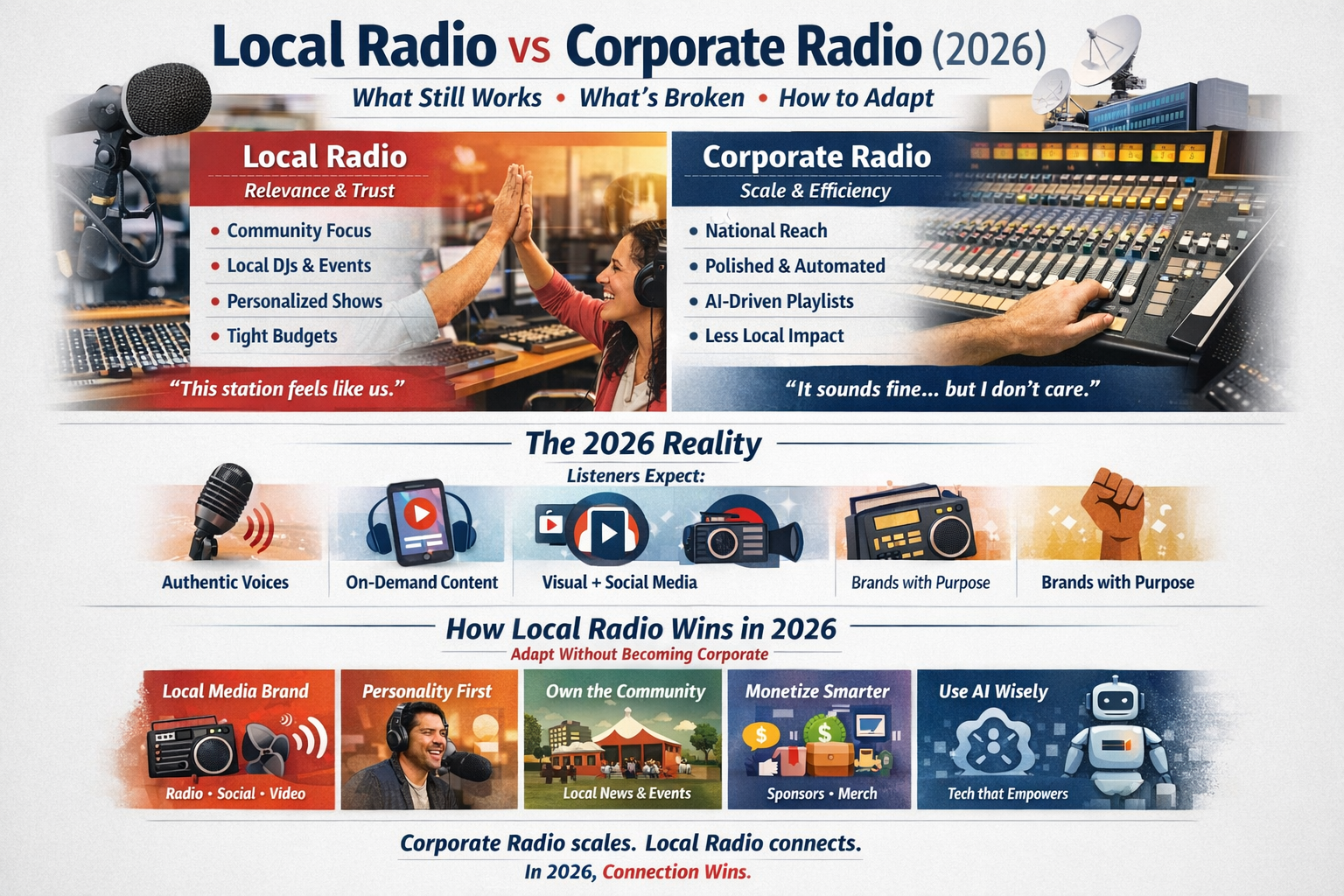
I saw a great post comparing the corporate radio world to local radio and all the wonderful things that could be if we were able to adopt the philosophies before consolidation. Local radio in my mind would be the goal. However, local rarely beats scale. I used to frequent the original Buffalo Wild Wings on campus at Ohio State. I used to bring back sauces and make wings for my staff at KLUC back in the day. Then B-Dubs franchised. One opened in Vegas, then seven. It became the spot for what we referred to as our “Friday Night Meetings”. Several staff members would meet there and brainstorm ideas for the station. The point is, B-Dubs went from being a spot on campus at Ohio State to one of the most successfull restaurants in America. Why? Scale.
Unfortunately, I'm a realist. I sat and broke down how the broadcast industry can recover the fun and excitement that drove the medium I grew up with and loved. There is only one way, and it would put major corporations out of business, but the only way to get there would be to re-regulate the industry. So, if I could wave a wand, here is how it would go...
1) There would be no foreign ownership of a licensed broadcast property.
2) No single company can own more than 80 signals nationally, and no more than 4 in a market. This would open up more individual ownership and diversity of programming.
3) You would need to change the Public Service rule to mandate at least three broadcast events per year that benefit the local community without profit to retain your license. You are allowed to cover expenses for those events, but beyond that, all profits must go to a community charity or betterment project. You can do more than 3 community events to derive profit, but there must be at least 3 that are pure community service.
4) These community service events would take the place of the PSA shows that get shoved into early Sunday morning, so those could be eliminated.
5) Next, you would need to limit the number of signals per market. Set up signal amounts based on market population. Basically, limiting one signal per 60,000 people in a market. The lowest limit cap being no less than 5 per market, and a cap of no more than 60 stations for the major markets.
By doing this for 10 years, we would prove to the market whether local radio can or cannot compete in a global world with streaming and other forms of digital media. It would be an interesting experiment.
Now...to be a realist, this will never happen in my lifetime. So it will take someone younger than me to press Congress to change the ownership rules, but from my lens, that is very far down the line, and that is if they (younger people) even care about preserving local radio at all. As I have told people, humans are the most adaptable species on the planet. Because if we weren't, we would all still be amoeba.
So the bottom line...that is a wish list. If we are going to be successful in 2026, we need to understand the landscape we are living in, and we all need to adapt and grow our skill sets beyond our comfort zone that we have lived in for most of our broadcast careers; otherwise, we are doomed to ride off into the sunset of irrelevancy. As I said, I'm a realist.
#change #leadership #growth #career #broadcasting